Claude Fable 5.1 API for coding, agents, and knowledge work
A practical guide to Claude Fable 5.1: published benchmarks, coding and agent workflows, API economics, and the checks that matter before production.
Model route
claude-fable-5-1
Route capabilities and availability follow the currently configured upstream channel.
What is Claude Fable 5.1?
Claude Fable 5.1 is Anthropic’s general-access offering for demanding coding and knowledge work. It shares its underlying model with Mythos 5.1, but applies additional safeguards. Our Mythos 5.1 guide covers the separate research-access offering. Source: Anthropic announcement.
For an API team, start with a concrete deliverable: a reviewed patch, a reconciled analysis, or a report with checkable sources. Define completion before the run, then measure the corrections a human still needs to make. This guide separates published evidence from LAYSO’s practical evaluation advice.
On LAYSO: use the model identifier claude-fable-5-1 only when the current catalog lists a compatible route. An informational page is not confirmation that an upstream channel is active.
Claude Fable 5.1 benchmarks and comparisons
Anthropic reports 55.8% on Terminal-Bench 4.0, 73.4% on CursorBench 3.2.0, and 1853 on GDPval-AA v2. The original comparison below includes the other reported evaluations. These are publisher results, not tests conducted by LAYSO. Source: official model page.
Production safeguards were enabled. Interventions count as zero for both Fables on OSWorld and for Fable 5 on AutomationBench; other interventions use Opus fallbacks. OSWorld uses the August 2026 task set, so earlier releases are not directly comparable. Terminal-Bench-Science uncertainty is ±3.5–4.5 points. Evaluation notes.
How to use the comparison: compare the same task version, tool permissions, effort setting, and completion criteria. A coding score, a knowledge-work rating, and partial computer-use credit measure different things; averaging them would produce a misleading “overall” score.
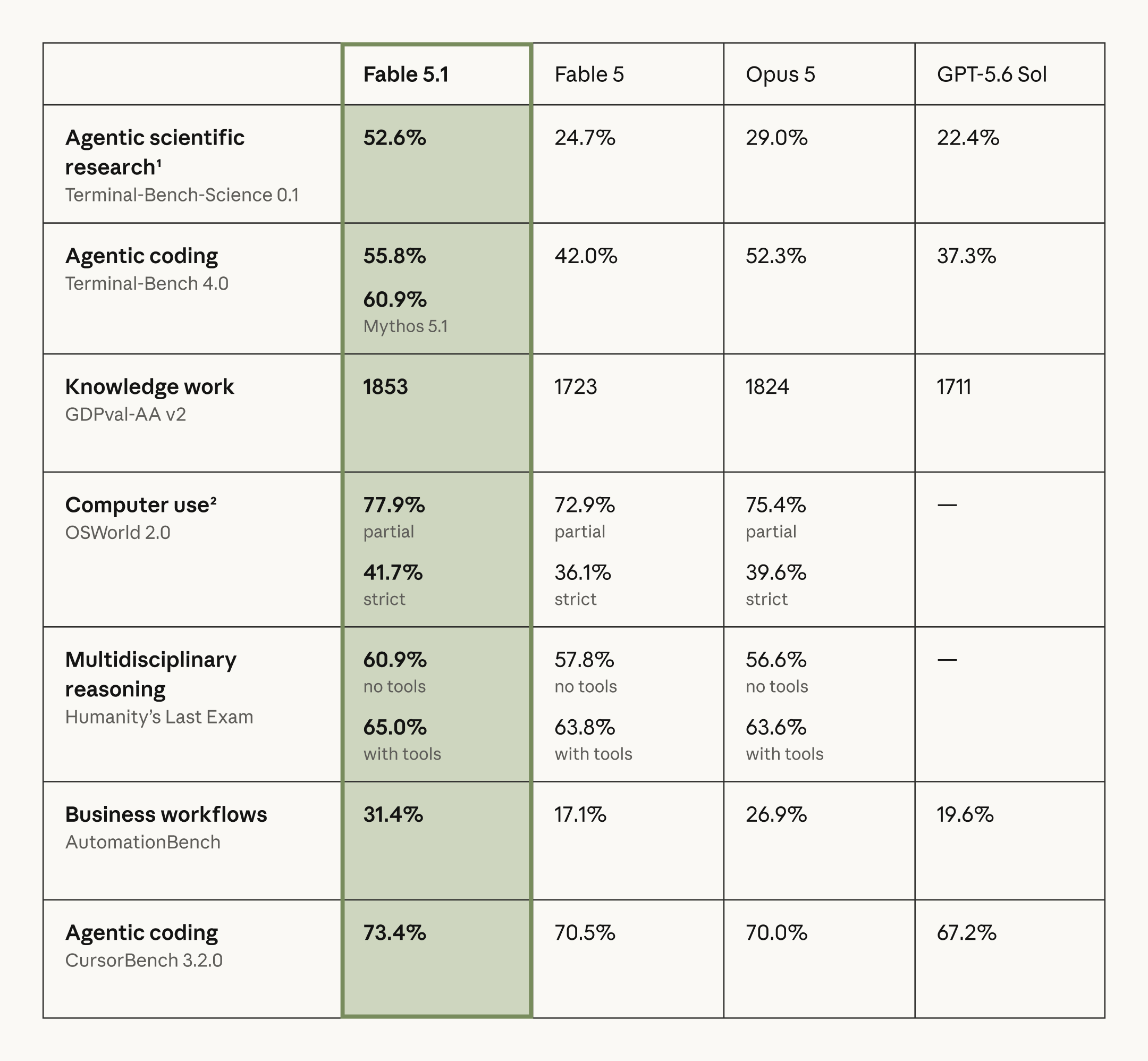
Published comparison from Anthropic. Most results are Fable 5.1 results, not Mythos 5.1 results.
Coding, agents, and document-heavy work
Anthropic describes codebase-wide development, multi-application agents, and analysis of visual documents as key use cases. Its emphasis includes checking work and recovering from failed steps. Source: model capabilities.
Coding: test the finished change
Give the model repository conventions, a reproducible failure, and explicit tests. Ask for the smallest complete change, an explanation of what caused the problem, and evidence from verification. Review migrations, permissions, and external dependencies separately.
Agents: define boundaries as well as goals
A useful pilot includes a read-only investigation, one reversible action, and a deliberate failure case. Record tool calls and require approval before external messages, payments, deletion, or production changes. Progress updates help reviewers understand what the agent has actually completed.
Knowledge work: make evidence reviewable
For reports, spreadsheets, and presentations, specify the audience and the decision the deliverable should support. Ask for source references and uncertainty labels. Verify totals, citations, charts, and file exports rather than judging the first draft by its appearance alone.
These are LAYSO evaluation suggestions, not additional benchmark claims. Compare accepted output per dollar and reviewer time saved, not just generated tokens.
Scientific research: the Venus mapping example
In Anthropic’s example, Fable 5.1 used historical Magellan observations to build a Venus elevation map. The announced resolved detail is about 2–3 km; the image’s 300 m label describes grid spacing, not independently resolved features. Source and image context.
The released Venus Opposite-Look Topography dataset is versioned and includes documentation, a license file, and a downloadable elevation raster. Consult those materials before using it for scientific analysis.
The three views below show the same example through radar, earlier altimetry, and the new elevation model. They illustrate a research workflow; they do not establish accuracy for an unrelated mapping task. The molecular-design and GPU-optimization examples belong to Mythos, and are discussed in the separate Mythos article.
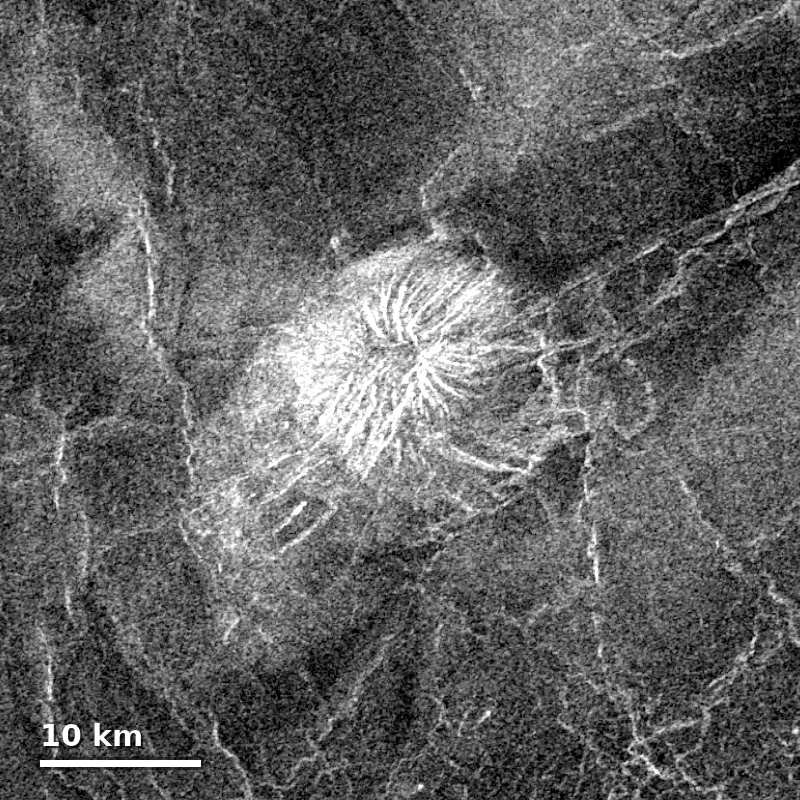
Magellan radar observation.
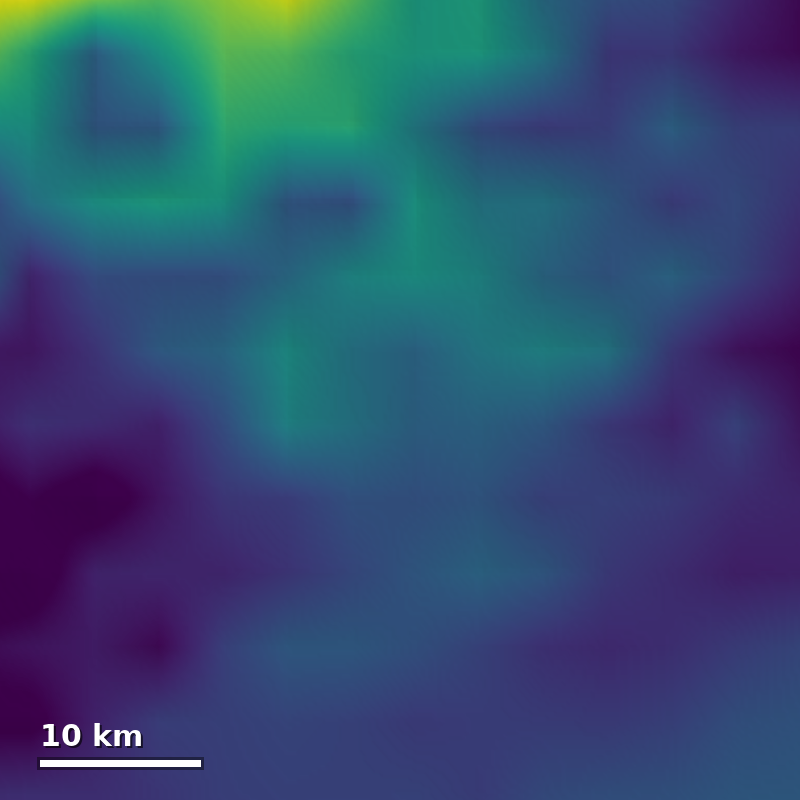
Earlier altimetry: 10–20 km footprint.
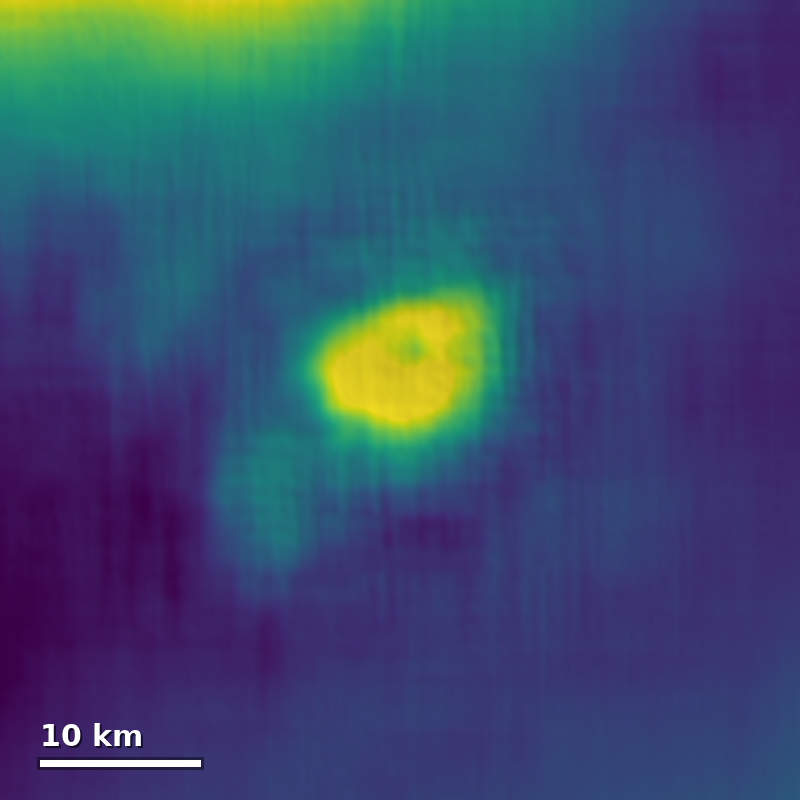
New elevation model: 300 m grid spacing, not 300 m resolved detail.
Claude Fable 5.1 API pricing and prompt caching
Anthropic lists $10 per million input tokens, $50 per million output tokens, and $0.25 per million cache-read tokens. It estimates roughly 25% savings on typical workloads and up to about 45% on highly agentic work versus Fable 5; actual savings depend on the workload. Official pricing reference.
Those reference rates are not the LAYSO selling price. Check the live catalog or the pricing panel below before budgeting.
Budget the complete run
Separate fresh input, cache reads, cache writes where applicable, and output. Include retries and tool costs. Cache savings help most when repeated context is actually reused; changing instructions and tool definitions can change that behavior.
For a migration, run a small representative batch before committing a larger budget. Compare cost per accepted result at equivalent quality. A low per-token rate does not by itself make a long, unsuccessful agent run economical.
Enterprise privacy, safeguards, and watermarking
Enterprise Frontier Safeguards
Anthropic’s EFS design places monitoring data in customer-controlled cloud infrastructure, with customer-managed access and review. Rollout is phased, and eligible customers may use zero data retention while awaiting EFS. These are eligibility-dependent Anthropic arrangements, not a privacy guarantee supplied by this LAYSO page. EFS details.
For your deployment, confirm which organization owns each log, who can read it, the retention period, and deletion procedures across both gateway and upstream provider. Do not assume a provider feature is enabled on every intermediary route.
Safeguards remain part of the product
Anthropic has refined its biology classifiers to reduce benign fallbacks, while keeping restrictions for dual-use research. Biology safeguards background. For specialized work, review the applicable program and fallback behavior before building a workflow around a particular model.
Text provenance is not proof of authorship
Anthropic describes a statistical text watermark with no hidden characters or identifying user data. Detection is probabilistic and less informative for short or lightly edited text. Watermark explanation.
For publishers, keep human review, source checking, and disclosure practices independent of a detection result. A watermark does not verify factual accuracy or establish ownership.
Claude Fable 5.1 API integration checklist
The following minimal request uses LAYSO’s Anthropic-compatible Messages endpoint. Keep the API key on your server and check route permissions first.
curl https://api.layso.ai/v1/messages \
  -H "x-api-key: $LAYSO_API_KEY" \
  -H "anthropic-version: 2023-06-01" \
  -H "content-type: application/json" \
  -d '{
    "model": "claude-fable-5-1",
    "max_tokens": 1024,
    "messages": [{"role": "user", "content": "Review this release checklist for missing verification steps."}]
  }'
With an Anthropic SDK, set the base URL to https://api.layso.ai and supply your LAYSO key. See LAYSO documentation for the gateway’s supported request options.
Preserved thinking and migration
Anthropic’s new-account rules require prior thinking blocks to retain their original preceding messages, system prompt, and tools. Altered context can cause an error; an optional non-strict mode drops affected thinking blocks instead. The rule is phased for Fable 5.1. Official integration guidance.
Audit custom compaction, system-message injection, and tool-schema changes. Check which upstream account rules apply to your route; do not assume that provider-specific flags pass unchanged through a gateway.
Before launch, test streaming, timeouts, malformed tool responses, rate limits, and unavailable routes. Keep retries bounded and require an explicit user action for billable tests.
Claude Fable 5.1 FAQ
Is Claude Fable 5.1 the same as Mythos 5.1?
They share the underlying model, but have different safeguards and access conditions. Fable is the general-access offering; Mythos is reserved for approved use. See the separate Mythos guide for those restrictions.
Does a LAYSO API key include a Claude subscription?
No. This guide describes the LAYSO API workflow, not an Anthropic subscription. Check your LAYSO balance, key permissions, active route, and current selling price before sending requests.
Are the benchmark scores independent LAYSO tests?
No. The image reproduces Anthropic’s published results. Use the linked evaluation notes and run your own acceptance tests before choosing a model.
Where can I check the current Fable 5.1 API price?
Open the LAYSO model catalog and search for claude-fable-5-1. The reference prices in this article are not a quote for the configured LAYSO route.